

As I said in the previous post (about Republican primary candidates in Utah Senate District 21), I don’t get to vote in June’s Republican primary, and that’s okay. You might say I’m not the Republican I used to be. But I attended a debate, and I have thoughts.
Here’s a video from the American Fork Chamber of Commerce’s YouTube channel. It’s the county commission portion of the May 19 debate. Thanks again to the Chamber for throwing the party and for posting the video.
Here’s the American Fork Citizen’s coverage of the county commission portion of the debate.
That’s it for the neutral information, if that’s all you came for.
(There’s no third post from me with notes on the other two races that would be on my ballot if I had one, a state school board race and a race for county clerk. Sorry, I don’t know the candidates.)
I can’t practically report and analyze everything these candidates said even in a single one-hour debate, and I’m sure I won’t do full justice to any of them, but here are my thoughts. For what it’s worth, I approached these races with little prior knowledge of any candidate and no discernable bias toward or against any of them—just some views of my own on several issues. I mention this because I led with my considerable bias in my notes on my district’s state senate race.
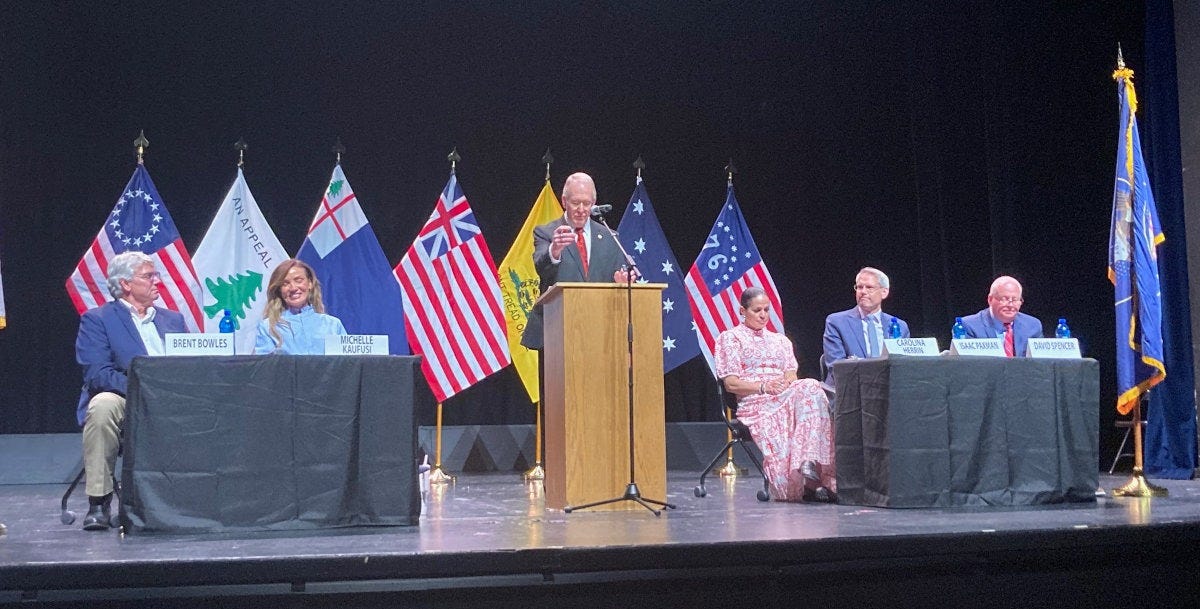
Utah County Commission Races
Two at-large seats are at stake on the Utah County Commission next year, Seat A and Seat B. None of the Republican primary candidates is an incumbent:
SEAT A
Brent Bowles
Michelle Kaufusi
SEAT B
Carolina Herrin
Isaac Paxman
David Spencer
I’ve watched Republicans grapple in Utah County Commission elections for decades, and it’s usually not pretty. Often it devolves into a narrow-minded competition to see who can declare most fervently that taxes are too high, and who can offer the most heartfelt promises to cut them, beginning with their own salaries and staff.
But county commissioners are both executives and legislators, charged to run a large county. It’s a full-time job. How low do you think their salaries can go? I think we should pay them well and tailor our expectations of their performance accordingly. Then again, I’m not running for a Republican nomination in Utah County.
I don’t love taxes. I think excessive taxation (not all taxation) is tyranny. In fact, I think it’s evil. But I also think county commission candidates who fixate on taxation at the expense (pun probably intended) of everything else are toxic to good government.
Recent, substantial county property tax increases took some hits in the May 19 debate. I was disappointed that no one connected multiple decades of foolish anti-tax obsession with the occasional need to raise taxes sharply, just so the math will math, as they say. Not that I expect Republican primary candidates to say anything positive or even neutral about taxes.
Seat A: Bowles vs. Kaufusi
Judging by what I heard at the debate, Brent Bowles is one of those narrow-focus anti-tax candidates. He even goes so far as to declare that bonding is also taxation. Rhetoric over reality.
Fortunately, Michelle Kaufusi is a different, more realistic sort of candidate. She served seven years on the Provo School Board and eight years as Mayor of Provo, and she talked sensibly about a wide range of issues. She didn’t proclaim her undying love of taxation; there’s no benefit here in sounding like a Democrat (which she’s not). She noted Provo’s award when she was that city’s mayor, for the city (of its size) providing the highest level of services for the lowest taxes.
Bowles by his own account got 64% of the convention vote, but he won’t even get close in the primary. And in November, when I get to vote in the general election, I’ll be happier to vote for Kaufusi than I’ve often been to vote in county commission races.
Seat B: Herrin, Paxman, Spencer
The obsessed anti-tax warrior in the race for Seat B, if there is one, is David Spencer, though for one evening, at least, he was more promising than Bowles. It probably helps that he has 12 years on the Orem City Council. But I can’t evaluate his service there; I haven’t paid much attention to Orem’s city government.
He says he got into politics twelve years ago to save the baseball fields in Orem. Caring about something like that is not a bad reason to join the fray, not at all. He wants to send a message that “the good old boys club” is over. (Does that mean he should be endorsing Kaufusi and his own opponent, Herrin? Best if I don’t take this stuff too literally, I suppose.) He wants to stop new high density housing, something I wish the state would largely leave to lower levels of government. And he wants the county to get all possible grants “with no strings attached.” I’m not sure what those grants with no strings might be, but a candidate can dream.
Herrin works in law enforcement and says public safety comes first—a proper view for a county commissioner, I think. She’s Legislative Affairs and Policy Director for the Utah Department of Corrections. She graduated Provo High School, naturalized in 2003, and voted for the first time in 2004. She wants county commissioners to be more engaged with UDOT and various boards, etc., than they have been. And I had the impression that she’s been active in the local GOP.
Paxman has solid legal credentials, including at the DOJ and in the Utah Attorney General’s office; served as Provo’s deputy mayor; and generally talked sense about things. He says he doesn’t make campaign promises, but he did say, if budget cuts are needed, they should be surgical, not across the board. He talks a little too much for my taste—though I share his religious affiliation, I think—about God guiding him into politics.
Two Issues
One, briefly: All five candidates were able to agree that cities, counties, and states should “stay in their lanes.” That’s easy to say but harder to do. I’d love to see them stay in their lanes and push back when others don’t.
Two, not so briefly: Someone asked about expanding the county commission, and I was glad. I’ve thought for years that we need at least five commissioners, but probably seven, instead of the current three. The tax-cut-obsessed faction may complain (again) that this will just be more government, and they don’t believe in growing government. But if we could get better, more representative county government, that expansion would likely pay for itself, and growth in other parts of government might be limited.
Herrin said five or seven commissioners is the way to go, but she wouldn’t support increasing staff. I’d be more concerned that the commission be properly staffed than whether the staff were smaller or larger with the change.
Paxman didn’t oppose expansion, but he wants to see how things work for a year before attempting dramatic changes. It seems reasonable—but after that I’d want some action.
Spencer said he’d have no problem going to five.
Kaufusi spoke favorably of her experience with a seven-member school board and the seven-member Provo City Council, the latter consisting of two citywide members and five representing districts. She said we should put an expansion on the ballot.
Bowles grumbled about salaries and bloated government, but said we should go to five.
County voters defeated a similar proposal in 2020 by almost a 60-40 margin, but in this county resident’s view it’s time to try again.
My Votes, If I Had Them
I’d vote for Michelle Kaufusi for Seat A. I think I’d still be undecided on Seat B. Here’s why: All else being equal, I liked Isaac Paxman better than Carolina Herrin, and Herrin better than David Spencer. But Paxman was Kaufusi’s deputy mayor in Provo, and that might be a bit too much of Provo on a three-person county commission. Thus I might prefer Herrin, who lives in or near Spanish Fork, I believe. (The third commissioner, Skyler Beltran, who is in the middle of his term, apparently lives in Lehi.)
I think I just made another practical argument for a larger county commission.
Thanks for reading.
Read my notes on Republican primary candidates for Utah Senate District 21 here.